Monday, December 16, 2013

Cross-posted from Facebook

Back in the 1960s, people would practice kremlinology, where people would guess who was in and who's out in the USSR based on pictures. When someone important fell out with the regime, the leaders would literally white them out in official pictures, rewrote history, etc. This allowed the regime to maintain the illusion (at home at least) that the Politburo knew what it was doing and was only interested in advancing the USSR.

Nowadays, we have something called the "Streisand Effect." The Streisand Effect is when someone tries to take something "off the Internet" (ex: a picture of Barbara Streisand's house), and people respond by reposting it almost endlessly, ensuring that the picture/information/whatever is actually far easier to find than before.

Now that North Korea has wiped the Leader's uncle off of the country's official website, the 1984 strategy of controlling the past in an attempt to control the future is competing with the obstinate attitude of the Internet. Wonder what Orwell would have thought about this.

http://arstechnica.com/tech-policy/2013/12/north-korea-attempts-to-purge-online-memory-of-executed-leader/

Saturday, October 26, 2013

Just a fun comic

How about a little fun for the weekend?

When it comes to people mixing and matching their passions of a sort of science and, well, anything else, there are two cartoonists that come to mind: Bill Amend, longtime cartoonist of Foxtrot, and Randall Munroe, best known for writing the XKCD comic.

Bill Amend admits he wasn't the biggest Math guy back in school, but he likes having fun with it now and has been since he was writing the comic Foxtrot when I was in elementary school. One recent example of Amend's geekiness10/20/2013

I wish I could give this comic its full due, but I'm a cyber guy, not a physics guy.

This is in stark contrast to Munroe, who was, quite literally, a rocket scientist who left his job at NASA of all places to work full-time on his webcomic. His works have become quite popular among scientists, and there are a ton of examples, such as this one:
Proof
This one is based off of one of Zeno's paradoxes, specifically one of Achilles and the Tortoise: In a race, the quickest runner can never overtake the slowest, since the pursuer must first reach the point whence the pursued started, so that the slower must always hold a lead. It's been disproven, but it's 

Sunday, August 7, 2011

A state like any other

Israel is a real geopolitical oddball. Not all of its Jews are from Europe and such; in fact I just visited relatives who've lived in Jerusalem and its surrounding areas since 1492, when Columbus sailed the ocean blue and King Ferdinand expelled the Jew. But its politics sometimes resembles the European states that many of its citizens left around 1945. For years now Israel's politics have been dominated by its dealings with the Palestinians. For many, this means security: building a wall to keep out suicide bombers, smashing Gaza to weaken Hamas, bombing Lebanon to destroy Hizbullah, etc.

But when the state was founded, the Israelis had more in mind than security. My father likes to say it was a state founded by socialists, people who believed that all men are created equal and should live according to his ability. Between the state and the kibbutz, romantically speaking, capitalism wasn't all that important. Laid low by the second intifada, Israel decided to liberalize its economy during the 2003-5 finance ministry of Binyamin Netanyahu (please excuse the wikipedia link; the footnotes should help). At worst, the reforms were derided by those in Labor (and even Netanyahu's Likud) as "Thatcherite." Some are more critical of him than others, of course. Haaretz attacks his "anti-Churchillian" policies that destroyed the egalitarian framework that kept the country together. The article blasts him for his Reagan-Thatcherism: "For instead of creating an economic and social powerhouse capable of meeting the challenges that surround it, he created a robber state that serves the settlers, the ultra-Orthodox and the tycoons." But his so-called "obeisance" to the market played a role in helping boost Israel's economy to its current heights. Israel is doing better now than it has in some time.

So why did 250,000 march for social justice as Israel enjoys 5.7% unemployment and 4.8% growth during an anemic worldwide recovery? The marchers blame wage disparities (the highest among the OECD countries) and (illiberal) wage disparities for their plight. Overall, these people feel that there is an economic miracle going on and they are not a part of it. The Netanyahu ministry is trying to respond- it "vowed to free up more state-owned land for development, build more low-rent housing and improve public transport. It also wants to lower dairy prices with more imports and boost medical staff numbers to address demands by striking doctors." But more and more parties are joining in. Kadima in particular is supporting it (and claiming that Netanyahu is igoring their demands), and parties as disparate in politics as the Arab-Israeli UAL-Ta'al and the rightwing National Union have thrown their support behind the protests.

Why now? For one, Israel seems to be "between wars" and unable to do much on the security front. Little can be done on the Palestinian question at the moment. The Oslo Peace Process has come to a stop; some respectable journalists claim that "The Oslo Process is over." Netanyahu is trying to fight the UN's recognition of the Palestinian state, but that's a lost cause as long as Oslo is frozen. Such a fight is determined at the level of the United Nations General Assembly, where no country can veto its decisions. That's how the UN got involved in the Suez crisis- neither Britain nor France could veto the General Assembly decision. Furthermore, the People's Republic of China got the "China" seat in the same way in 1971. Unless Israel can convince a majority of the 193 members of the UN that it should not recognize Palestine, then Palestine will be seen as a sovereign country with its own representative. Perhaps they feel that America's ability to veto its move to the General Assembly will be enough. Although I wonder, then, why France and the UK did not prevent the Suez issue from going to the General Assembly...

Regardless of the maneuvering on the Palestinian question, it is interesting to see that Israel's population wants to focus on economics instead. Israel is not an Arab autocracy that is trying to maintain its gerontocracy; its closer to Spain's economic protests, even if the Arab Spring had its own economic elements (the Tunisian revolt, and through it the whole movement, began when one Tunisian burned himself over his economic situation). It is just a normal country with normal problems, and that is what the economic protests remind us about.

Sunday, July 24, 2011

The benefit of waiting for information

There is a very interesting theory about the Spanish 2004 election that occurred three days after the March 11 bombings. Conventional wisdom says that Spain voted to throw out the governing party, which was polling well, because they were scared into "appeasing" the Islamic terrorists by leaving Iraq.

There is another view however: Al Qaeda did not lead to the defeat of the Partido Popular (PP) in Spain. Soon after the bombings occurred, when it wasn't entirely clear what happened, the PP was quick to blame the Basque separatist group ETA, even after it became clear that ETA was not at fault. Why did they persist in blaming ETA? On one hand, the PP's crackdown on ETA was popular. On the other, very few Spaniards backed the Iraq War. This helped lead the PP to maintain that ETA was behind the attacks even when ETA itself denied it. The PP feared that the voters would back the anti-war PSOE because the war led to the bombings.

Instead, this rushed conclusion that ETA was behind the bombings led many voters to believe that the PP was trying to distort the truth and led many who would not have voted at all to back the PSOE. If the PP had been more honest (although some of them still believe it), they could have said something along the lines of "we are strong, we will not let the terrorists determine our foreign policy." The PP may have gotten won term as planned.

Well, it's a theory. But it's something to keep in mind. Many of us leapt to the conclusion that an Islamic group was responsible for the Norway attacks, including yours truly. To be fair, an extremist Islamic terrorist group claimed responsibility for it. As we all now know, it was actually done by a White Christian right wing extremist who seems to think that killing civilians (and the Prime Minister) will prevent Norway from becoming communist/Islamic.

This is why it is so important to wait for information first...

Friday, July 22, 2011

Why Norway?

That was my first thought upon seeing the headline. It was most likely done by a group related to Al Qaeda, if only because Norway doesn't have many enemies. But why Norway? It isn't leading the charge against terrorism in a high profile way. It isn't leading the fight in Afghanistan and Iraq like America is. Norway hasn't drawn any nasty cartoons lately (in case you've forgotten, that was Denmark, and Norway said sorry for reprinting them). Even Reuter's attempt to figure out what groups may have attacked Norway neglected to ask: why Norway? Most of the groups on the list are regional in character (the Islamic Movement of Uzbeckistan is probably more interested in Central Asia than Scandinavia for instance), and the closest any of them get is an LeT man interested in the Danish cartoon scandal and a Somali terrorist who was born in Denmark.

Okay, they're both in Scandinavia. But that's about it.

One argument is that it didn't really matter to the terrorists who they were killing, that they just want to kill, and Norway is just another western country on the list. But that can't be entirely true. For one thing, if someone wants to commit murder, he doesn't necessarily have to do it on behalf of some greater cause, whether it be Timothy McVeigh's extreme anti-government stance or the creation of a global caliphate. Terrorism itself is defined as the use of violence against civilians in the pursuit of political aims. Terrorism without the political aims is simply murder, and the attack itself may have failed in one aim: killing the prime minister, as Rodrigo Javier suggests (See his twitter post here). But why kill the prime minister in the first place?

One might point to Norway's foreign policy. Norway contributed troops to the wars in Afghanistan and Iraq. In the case of Iraq, Norway originally sent 150 troops, but withdrew the bulk of them in June 2004 after it became clear that the Norwegian public did not care for the war, and withdrew the last ten in 2006. Furthermore, it still has troops in Afghanistan and Libya, partially due to its NATO obligations (the same goes for Germany and Turkey, both of which initially opposed the war in Libya). Perhaps, then, the attack was done to jolt Norway out of the war just as the March 11 attacks on Spain helped get the Spanish out of the war (the situation is far more complicated than that, but the point still stands). That makes the most sense. But that is not a sufficient reason. Other targets loom larger in the scope of who "should" be attacked. Britain and France, for instance, have far more troops there. France in particular has carried out one-third of all NATO aerial strikes in Libya, and must have more of a role in Afghanistan than Norway does. So, why?

The answer, as far as I can tell: opportunity. With the strengthening of visa regimes throughout the Western world, it is harder and harder to send people to one country or another. The attempted Times Square bombing in particular was perpetrated by an American civilian. Perhaps a Norwegian finally took Al Qaeda's call to attack Norway to heart, and was aided by Norway's environment of openness. In a land where you can find anyone's email address and the classes seem to mix better than elsewhere, security seems to be low on their list of priorities.

To put it succintly: if it was caused by Islamic terrorists, then it would be due to Norway's own participation in the war on terror, a desire to force it out of Afghanistan, and the opportunity to strike it. At least I've answered my own question. I'll refrain from saying more until I know more. It might not have been Al Qaeda or such after all...it could just be some madmen who are fighting on behalf of the environment, or a fascist group. One might argue that neither group has been active in Norway for some time. Perhaps; but if you asked me a week ago if Norway would be a target of Islamic terrorism, I would say no. Let's see how the story develops...

Wednesday, June 29, 2011

Take Two, beginning with Libya

Let's try this again, shall we?

A lot has happened since that post in February, 2009, and it would take a while to recap it all. So let's just get back in the swing of things with a very interesting article from the New York Times.

This one is about the difficulty of nation building in the ruins of the ancien regime. The media has focused a lot on the war, but what I find more interesting is how the rebels have been trying to rebuild their country in the midst of the conflict. In this area of the Nafusah Mountains, the rebels have held their ground and built a new society in what was once Qaddafi's Libya. This is in spite of the fact that this rebel held territory is much closer to Tripoli than the areas out in the east; weeks earlier the territory had been on the brink of defeat.

But the politics of the situation is not as interesting as how the city is run. The proverbial trains still need to run and administration still has to be done. For instance, in spite of the war many of those who worked for Gaddafi's government have retained their old positions in what is supposed to be the new Libya. This includes the police, many of whom are Gaddafi's men in new rebel uniforms. The article never delves into why this has happened, but one can see why. Not all of these people were loyal to Gaddafi because they loved him, but simply because they needed a job and he was willing to give one to them. This is true throughout the Middle East, where jobs are given to many to make it economically difficult for them to revolt. After all, why would one revolt against his employer? Furthermore, these people know how to run a state, and can run the trains that are working well while the rebels try to put the other ones back on their respective tracks.

At the moment, this region has also embraced the idea of "freedom of speech," or at least the right to protest against its former dictator. Seven new newspapers have been launched in this area (and distributed through the magic of photocopies), proving that at least in this part of the world the newspaper industry is not dead.

Honestly, the entire article is worth a look, just to see how much has changed...and how much work it takes to build a new state and fight a much stronger foe, even when you have wealthy Libyans contributing from abroad and an ill-equipped army against a much stronger one.

Yes, this is my first new post in more than two years, and I plan to do this on a weekly basis at worst, but preferably a daily one. Hope you like the revived blog!

Monday, February 2, 2009

The Blair Lecture

I just went to the Tony Blair lecture, and...uh, I don't want to forget anything. They wouldn't let us bring a lot of stuff, like recording devices for instance. So...yeah...

So why not use a blog I haven't updated in months?

Anyway, this was at the Issam Fares lecture at Tufts on February 2nd. Sorry if the notes are rough!

The World: To make a peaceful world where we banish the issues of Global Warming, hunger and disease in Africa (which he is quite passionate about), we have to deal on a global basis of partnership and create a world order based on justice and partnership- the time when the West could impose their will on the rest of the world is over. We can not and should not do this. We should not act in morally restrictive and anyway useless national fashion- the whole world must act together. But there is one big problem with this...

Islam: Samuel Huntington once proclaimed that the Cold War would be replaced by a Clash of Civilizations- and it is the belief that such a clash exists that motivate some radical Muslims to think that committing suicide and killing innocents will somehow reconcile you with God.

Is Islam in a transition phase? Perhaps. And if we want to influence it at all, we cannot keep it in a strictly military manner- we need to do things in terms of persuasion, and overall...

Blair on the Middle East: During a tour through Palestine as the envoy of the Quartet (the US, Russia, EU and the UN that is supposed to negotiate or at least guide the process as one bloc), Blair's (Palestinian) guide once said, "Moses, Jesus, Muhamaad...why did they have to come here?"

He said that there are a lot of conflicts, and while the Arab-Israeli conflict was not the cause of the conflicts that rile from Somalia to Iraq, or even a cause, for they would exist without Israel, but solving it is necessary and the most important thing they can do to bring peace to the Middle East (which I will acronymize to MENA or "middle east and north Africa"). To solve this, we have to start now. We have to let the Palestinians rule themselves, instead of promising it as the Israeli settlers are allowed to take the best land uninhibited. Perhaps more importantly, we have to give the Gazans a way out, for the Gazan strikes has destroyed the infrastructure- and the hopes of many. We must not isolate Gaza from the West Bank!

On Iraq: Blair openly acknowledged that he could split the room on the question "Do you still think it was the right thing to do?"...or not XD. Apparently all the information he had was put on a website, though I remember reading that the whole event was rather controversial. I believe there was some rather odd event that put a shroud over the whole affair, but it may be best not to reference it directly in such a post as this. Still, he seems to have acknowledged the damage, and the best he could answer was that Iraq would not have been less dangerous if Saddam was still in power.

Okay, onto the lighter stuff before I forget absolutely everything.

On his command of communication: Apparently he somehow dodged using a mobile or a blackberry for his ten years in power as Prime Minister of the United Kingdom and Northern Ireland. In any case, he said he has one now- which prompted Tufts President Bacow to comment that he was trying to get rid of his. Blair remarked he loved the communication ability his gave him- and had to refuse Bacow's offer of his Blackberry.

More problematic was something that happened in his first years of power. He was at a news conference with the French Prime Minister at the time (a Socialist, given the timing), and he made the mistake of giving a live conference in French. He's good, but not that good: When asked which policies of the French PM he wanted to emulate, he meant to say, "There are many policies of his that I would like to emulate."

It came out as, "I prefer the Prime Minister in many different positions." No, Blair's married. To a woman.

On Ireland: Before Blair had a Bush-shaped albatross around his neck, he was famous for many other things. His New Labour coalition created growth and prosperity (which seems to have gone down the toilet recently), he pushed for ground troops in Kosovo during the Balkan wars, was (and is) passionate about African aid (and rock stars who want said aid), and, perhaps most importantly given Iraq, pushing for peace in Northern Ireland. While there, his wife Cherie got pregnant. An Irish delegate came up to Blair and remarked on how wonderful Blair is blessed with yet another child and inquired about the name of the child. Blair said "Well, if it's a boy, then we'll probably name him after his grandfather," and thought nothing of it.

A few months later, the delegate came up to Blair and said, "remember that fortutious conversation?"

"Well, I put 1000 euros on his name..."

I hope you guys got something out of this!

Tuesday, November 11, 2008

Remember, Remember, for we should never forget

I know very few people read this blog, but try to remember the 11th, not the fifth, of November.

89 years ago, on the 11th minute of the 11th hour on the 11th day on the 11th month, the worst war the World had yet seen finally ended. On that day, many hoped for peace. True, many of them also hoped for glory, but the people on the field rarely thought of that- they just wanted to survive. They saw possible friends die on the field that day. Some of them had played football together in the Xmas of 1914 for crying out loud! Those soldiers, in another life, were or could have been friends; due to the war, people with similar ideas never had the chance...

By that day, the hope was not for a peace built on quicksand like the Treaty of Versailles; they wanted the Great War to be the War to end all Wars, the last time war would ever be fought. The fact that the peace didn't even last a year- as Central and Eastern Europeans fought to carve out their states from Austrian, Hungarian, German, Turkish and Russian territory- but no one really wanted that. The hope was that Wilson would be able to lead us into a new world, where war wasn't just a memory, but its very recurrence unthinkable.

The fact that he failed is not the same thing as wanting to fail. He really did hope he could save the world from other wars. Sure he was a racist and had a nasty messiah complex, but he did believe what he said. He wanted no more wars.

I believe the British and their ex-colonies wear poppies to remember those who thought they were fighting to end that war. Sure it may have been for glory at first, but there was a genuine hope that the Great War would be the last War.

We Americans don't have such a tradition. Maybe we should start it. For it does not stand for war, but for those who hoped there would be no more.

Monday, November 10, 2008

Can We Do It? Jesus Christ that's not the Question anymore!

Okay. The election was a week ago. In that span a lot has happened.

And yet we're [my college] looking back on the Bush years as some bygone era that we should be glad to see the back of, and Obama is still some wonderful thing.

Someone needs to poor a bucket of water on us. The time for enthusiasm was some time ago. Barack may mean "blessed," but Jesus Christ (Christos: Good news)! Wake up!

Looking back on history, we've only rarely had presidents who can unite us in any meaningful way (Roosevelt after the New Deal, Eisenhower). Furthermore, a magical Super Man is almost unheard of in history. Look at our supposed heroes!

Washington: Rare. Like, really rare. Besides, can anyone of us name something he did while president?

Roosevelt: A great man, if flawed. His New Deal hit it well for a while, especially with the poor over the grumbles of the rich. Then he tried to pack the courts and smashed his popularity, as the 1938 campaign demonstrated (he tried to run rebel candidates against conservative Democrats. They failed).

John F. Kennedy: The King of Camelot didn't ascend to his throne until his postmortem. Cuban Missiles and Nasa aside, he authorized and botched the Bay of Pigs, failed to get most of his program through, pumped up our Vietnam presence, and ignored Civil Rights until late in his presidency. Third year to be specific.

Ronald Wilson Reagan (6 letters each!): For some reason the right has siezed on this man as the Saint of Conservatism. Really? His massive tax cut in 1981 was reversed by 2 massive tax increases in 1982 and 83. Mondale in 84 said that Reagan would increase taxes again (his point? "I will raise taxes. My opponent won't tell you. I just did."). In 1985 Mondale was proven right.

As for everything else? Reagan did little for abortionists (Sandra Day O'Connor and Kennedy were centrists, with Scalia as the lone "true" conservative of his picks). He helped bring down Communism, but he had help (and ran huge deficits for "victory" in a nuclear war at that.). To be honest, I tend to do better in noting his successor's achievements than RWR (you know, greenery, a limited war with Iraq, etc)

Oh, and Teddy Roosevelt, the posterboy for American Greatness, Trust Busting, and Imperialism. He's awesome and may well be one our very best, but he was also a mistake and why VPs tend to be filled these days by, apparently, idiots and old wannabes these days. Just ask Qualye and Cheney. Or Mondale. Or Bensten. Or...Actually, I think the idiot thing was a recent Republican phenomenon, apart from Andrew Johnson.

Well, how about foreign leaders? This is called "A view on the World," right?

Most of those, such as Frederick the Great, Peter the Great, Louis XIV, Napoleon, Maria Theresa and Joseph II of Austria and their ilk are rare dictators that we would no longer stomach. Some, like Peter I and Joseph II had problems satisfying their base (especially Joe, who actually ennobled Jews).

What about politicians? If picking presidents of our country was hard, who could compete?

Charles De Gaulle, who revived French pride and gave them an overlarge view of themselves

Tony Blair, who will be remembered for devolution, Saving Northern Rya-Ireland, and following Bush into a war that destroyed his popularity (why did he win the following election? The conservatives would've done it too!)?

Some Spanish guy I must be forgetting?

Otto Von Bismarck, who put the words "trickery, deciet, and Blood and Iron" in diplomacy and pretty much master-minded much of international politics?

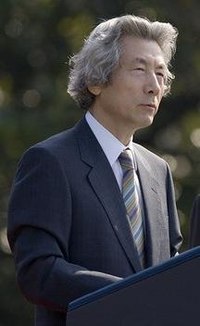
Junichiro Koizumi, who privatized the Post Office, did some other stuff that I can't remember, and has The Best Hair Ever (see above)?

...

Okay, Obama? If you want to prove your mettle, you need a new hairdo. We need more people with awesome hair.

Still, we need to temper our expectations. He may well be an improvement on Bush, but we won't know for some time, okay? He'll do something, and it might even be good, like in the days of Johnson (Please ignore Vietnam), Nixon (Please ignore his crookedness), and Clinton (please excuse the political skill of the man who destroyed Universal Health Care in america for two decades and somehow let his last years get dominated by his more frivolous undertakings until he finally touched on Israel and Palestine. And we want our White House dishes back.)

And suddenly I'm hoping that Koizumi takes over Japan again. And TR comes back with a new haircut. Can you believe that look with a stache? Sigh...

Wednesday, November 5, 2008

Bright, Articulate, and Clean...

Articulate?...has anyone watched the debates?

Still, he won and everyone on my campus is ecstatic! Ill have to talk more later...

And whatever the system, he definitely won, eh?

Sorry for being a little short; I'm in the middle of class right now. Still-

OBAMARAMACAMADAMALAMACHAMAGRAMARAMAWHAMAWAMAOBAMA!!!

Tuesday, November 4, 2008

Don't forget to Vot!

Vote Damnit! I live in the fakest America in all of America! We're so fake that we'd vote Democrat even if the Presidential candidate was Satan himself! Wearing a Yankee uniform!

After all, we have to...

1. Income tax ban? Well...

2. Decriminalize small chunks of marijuana!

3. Drive dog racing underground by banning it! WOOO!

And that's from Massachusetts! We all have important things to do!

Just remember: your vote counts! Whether you be a Floridian in 2000 or a Washingtonian watching recount after recount for the governorship. Come on! Vote vote vote!

We're not some dictatorship!

Sunday, November 2, 2008

Yisrael is insane

Hello from fake-America!

Well, if North Virginia isn't "real" Virginia, than you can't get more "real" than Taxachusetts, which elected the first black senator since Reconstruction and had Republican governors between 1988 or so to 2006...And at least one of them was a centrist hated by Jesse Helms and the other one is the Antichrist aka Mitt Mormon Romney.

Anyway, I forgot about this. Sorry! There went the systems, eh? Well, how about two opposite ones?

Canada is basically Britain, where the upper house is filled with a hodgepodge of party toadies- that is, installed by the parties in power over the years without any formalities such as elections (since Canada has mostly been run by Liberals over the years, this means that Liberals control the Senate). In Britain the MPs and the population realized how stupid a House of Lords was back in the 1900s, when it was stripped of most of its powers. Nowadays it has lost more and more of its, ahem, charm (You can't inherit seats anymore, for instance, and it will be elcted- thus dragging Britain into the 19th century or so). Hopefully Canada will join every other country in the Western hemisphere at some point, but the fact that it's mostly unchanged since its founding in 1867 is a tad unnerving.

Never mind the fact that the "first past the poll" system has heavily favored the Quebec separatist party, the Bloc Quebecois, thus preventing any stable majority governements for years now. Perversely, the Reform party- then a Western conservative grouping- had ensured the Liberals majority governments from 1993-2004, but their merger seems to have made the Conservatives stronger. But all this has done is guarantee minority governments; 2004-8 has seen 3 unconclusive elections in four years. That's insane. Then again, this is pretty much our system, except the Speaker of the House is pretty much the dictator thanks to extreme party loyalty and the President is the Governor General and doesn't seem to do much.

Think: What if Cheney was speaker of the House and the Senate didn't exist? Anyone convinced of Cheney's power should understand now.

Israel? That makes Canada look excessively stable.

Israel has had a Proportional Representation system since its founding, and it mostly demonstrates the problems of PR. You see, it works on the idea that if a party gets at least 2% of the vote, it should be in government. In this way it's extremely fair and a two party system doesn't exist, but it also means that a lot of parties only get a few seats in the Knesset (out of 120 total), and a few parties still get out on top. In the last election, five parties got more than 10 seats; Kadima got the most at twenty nine seats, less than a fourth of all the seats available. This means that the parties have to horse trade a lot to get everyone on board. The new election in Israel is going on right now because the new leader of Kadima refused to increase handouts and keep Jerusalem undivided, which is what the shas party wants.

This also means that the Grand Coalitions of Germany are far more prevalent in Israel, since it's difficult only to reign with a big party and a few (er, maybe more than a few) religious groups with 2 or 3 seats each. How bad is this? Here's the government

Kadima (Centrist grouping founded to give Ariel Sharon a way to run without depending on anti-Palestinian land deal Likud)
Labour (once dominant and hoping to get the next election; still somewhat socialist)
Shas (a Sephardic religious grouping; supportive of synagogues and such, obviously.)
Yisraeli Beitenu ("Israel is our Home," it's a right wing secular grouping and once solely the voice of Russian Jewish immigrants. It's really rightwing and is similar to Likud on some issues. Given it's suspicion of religion, it's sort of ironic that it's in the same coalition as Shas)
Pensioners (a protest party for pensions, obviously)

Yeah, so there are ex-and not so ex-socialists, Ex-soviet Jewish right wingers, renegades who joined together in support of Ariel Sharon, Sephardic Rabbies, and for some weird reason pensioners. I might have missed a party or two too.

Is this, and can it be, stable? Heavens know Italy realized this was stupid a long time ago, having the FPP system from 1993-2006 and since 1993 reformed itself into a two coalition system. And, given American politics, this would be a stupid idea; if Israel- a country of 7 million people- has at least 10 parties with seats, then one can only imagine what would happen in a country with fifty states and 300 million people.

Let's just leave those two countries out of any electoral debate, okay?

Wednesday, October 29, 2008

Why would Iran want a nuke?

No, seriously. Why?

Non-state Actors: Which ones? Hamas would say no way in hell. I mean, come on- they want a unified Muslim Palestine, not a Palestine with a mushroom cloud over it! That's crazy! Hizbullah wouldn't do it for the same reason- And Lebanon is smaller too! And Al Qaeda? Al Qaeda hate's Shiites, and wants to install a world-wide caliphate that would rule like the caliphs of old. In other words: No psuedo-democracy in Iran and no Supreme Leader of Iran. Iran wouldn't gain.

Israel: Has second strike capabilities. Al Khamaeni is hardly the least rational man around (the President has no power in that regard), and probably understands that Iran would be wiped out in case of nuclear war. Or, more likely, when it got a nuke. I don't think he wants that. Notice that there has been no direct Israel-Iran War, for instance- simply terrorist allies who have no interest in nukes.

America: See Israel, except Iran would really have to work on delivery systems and build lots and lots of nukes. Did I say lots? Well, we have 10,000 nukes...And we'd probably attack them immediately. Stalin lied about how many nukes the USSR had upon testing because he thought that America would nuke Russia if it thought the Soviet Union had dropped its one and only nuke.

I have a bad feeling he was right.

Soooo why? I think I have an answer:

Didn't the CIA say that Iran ended its Nuclear Weapons Program in 2003? Didn't something happen then?

...OOOoooooooh!

We all know now that Iraq didn't have Weapons of Mass Destruction aka Nuclear Weapons and/or chemical weapons. But the 2002-3 debate wasn't about that; even the French thought Saddam had it. In 1991 we learned that Saddam was farther ahead in his nuclear weapons program than was commonly thought. In 1980 Israel striked the Osirak reactor under suspicion of the creation of nukes. And France designed the Nuclear reactor.

And where did Israel get its nuclear technology? FRANCE.

No, I'm not insane. There's a connection.

You see, The French intelligence (probably less faulty than our CIA) also thought that Iraq had WMDs. The French just saw things differently: Did we have to invade just for the suspicion that his nuclear program was ready? Would it be so bad if Iraq had one? Israel's certainly didn't seem to do much. And the French get money out of it by selling technology! Why not?

Iran would say "Us!". And if Iran has stopped its program, it's because we gave them a reason.

Maybe I missed something...why would Iran want a nuke?

Obamamercial

Sooo Obama just said that he's going to give us back our democracy.*

That's rather impressive. Zilch stuff overall, since nothing has changed in the last 30 years or so. That change? 18 year olds can vote. That's it...

Unless he wants to turn us into Switzerland.

You see, Switzerland does have an executive branch, but its legislature tends to do relatively little, since there are lots and lots of referendums. You know: guns, privatizing health care, whether or not Switzerland should join the UN, etc. You might not want America to be a Switzerland, though- all the males are soldiers who have their military equipment nearby at all times. In that way Switzerland will be ready for war with Germany, America, or the Soviet Union. The Swiss even contemplated having a nuke.

And you all know America would ban all forms of taxation if given the chance by referendums.

Or he could mean Libya, where there is no legislature whatsoever, since "everyone" actually votes in all the policies. Well, if it wasn't a Qaddafian dictatorship anyway. But only those who think Obama is a Marxist Muslim Terrorist would actually believe that.

Unfortunately, it probably has nothing to do with political reform- unless you consider unitary Democratic government with a brain-dead Republican opposition a "reform." Sigh...

Just as long as he doesn't want to turn us into Canada, where the Prime Minister is a virtual dictator and the Senate is stuck in the 18th century (where all the senators are appointed by the Prime Minister). I mean, Bush wasn't able to throw the entire Democratic party into Guantanamo. That's because the Congress wouldn't allow it and the Supreme Court would declare it unconstitutional, among other things.

Besides, our Senate used to be like that. Notice how we gave up on that?

Yeah...just a little annoyed, that's all.

*I haven't actually watched it, but it's nice to hear I actually missed something. He might not have actually said that. Please tell me he didn't say that.

Tuesday, October 28, 2008

Is this all there is?

It's really, really damn hard to see how Obama can lose this one. Even if he loses the popular vote, it looks like he might win the electoral vote.

Yeah, the Democrats are going to love this.

But surely this won't help much in terms of political reform.

...Wait, what you say?

There are a fair number of people who look at our system and say it sucks. Sure Churchill said it, but I don't mean "Best one possible of all the democratic systems." Look at it! The 2008 election seems to have gone on longer than all of the India-Pakistan and the Israel v. Half of Arabia wars combined. I've been paying attention since 2005. Do you realize how stupid that is? I've been paying attention since Bush's reelection. That's like seeing Blair get reelected and hearing Labor and the Tories wonder who will follow.

Okay, that KIND of happened, but it's not like they tried to keep track of 20 different candidates!

And how about money? In the span of September, Obama raised the net worth of Mitt Romney: $150 million. That's got to be the GDP of more than a few countries! And GDP is how much they produce in a year.

Compare that to Canada, where the campaigns don't seem to drag on nearly as long or are nearly as expensive. Or France and Mexico, where campaigning longer than a set amount of time is actually illegal. Or Britain-

Wait, didn't they just go through a problematic cash-for-peerages scandal?...uh...

Well, how about the electoral vote? Few other countries work that way. And our Congress has made itself a laughingstock in the last 20 years, where a good number of them rely on lobbyists-

Erm,

Well, at least their Prime Minister doesn't, uh...just watch


That guy is now the Prime Minister of Australia.

Okay, so their problems probably have nothing to do with First Past the Post or Proportional Representation systems. Still, our system can't be the best, right? With the end of our own election looming, it might be best to see if we can do any better than this.

Yeah, I'll show you guys ome systems, and it's rather important. After all, our choices are one half of the McCain-Feingold act on campaign finance reform and the other one is, allegedly, a progressive who believes in progress. So let's progress!

Monday, October 27, 2008

First!

Hello World.

Yeah, first blog, shut up.

Anyway, I can't promise much. Thing is, though, I've been reading up on world affairs for quite some time. Of course I have an opinion. We all do. And we all want a way to explain it.

Well, I'm speaking out. How about you?

I mean hell, it's not like I'm talking about videogames.

yet.

................................

So, for what's happening now:

1. Not much, relatively. Aside from a massive financial crisis I don't completely understand, which is pretty much the Most Important Thing Ever.

2. 8...er, 7 days until the Most Important Election Ever Yet is over. too bad I started the blog after all the interesting parts.

You know, when McCain's election was dead. Like, three times.

The horror of Huckabee's victory. And don't forget milking the endorsement for all that it's worth!

Watching the slow descent of Bill Richardson, though his ads were fun.

Giuliani and the Lightning Bolt at the abortion question.

Edwards being transformed from 3rd place to ignored to laughingstock to just plain sad, if...uh, let's not talk about it.

Well, this has been the most entertaining election we've had in some time. Too bad that, in these last few weeks, it's turned into a predictable ending. Ah well!

8 days more, another day, another destiny...
On this never ending road to calvary...